We build the software operating layer for allied warfare
01/Product
Our product
0%
EMISSIONPOSTURE OKLINK14:32Z
FHN
COP · APP-6 · MGRS · CoT
MESH4 NODESLINK
Multi-bearer mesh · CRDT
EMCON · DARKPOSTURE OKLINK
ALL RADIOS DARK
Controlled emissions · local continuity
MODULESSIGNEDTUF
COP ISR LOG BRIDGE + you
Signed modules · verifiable updates
LINK LOSTQUEUELOCAL
12 objects queuedResync on reconnect
Degraded mode by default
02/Design directions
We learnt from the field.
01
Dispersion buys survivability
A centralised command post is a target you can find, characterise and strike. The function spreads across dozens of mobile nodes: vehicles, drones, remote sensors and dismounted teams. Each node must stay autonomous, operable by a non-specialist, and rejoin the fleet as soon as the link returns.
02
The spectrum is contested at all times
In the Baltic, jamming and spoofing of satellite signals disrupt even civilian maritime and air traffic. On the front, reference reporting puts Ukrainian drone losses at roughly ten thousand per month, mostly from electronic warfare. A system that assumes the signal is available is not a combat system.
03
Degraded mode is the default mode
Equipment that refuses to start because a signature expired, a licence server is unreachable or an update was interrupted is abandoned. In July 2025, a global satellite outage denied Ukrainian units a link for about two and a half hours. Hardware must always boot, and degrade its posture explicitly rather than refuse service.
04
Tactical and industrial cycles diverge
A countermeasure now appears in two to three days, while re-qualification takes years. The most sought-after components need weeks of lead time and vanish from the market within a few years. Abstraction turns a target change into integration, not a full rewrite.
03/Blog
Newsroom
Engineering notes, field reports and publications.
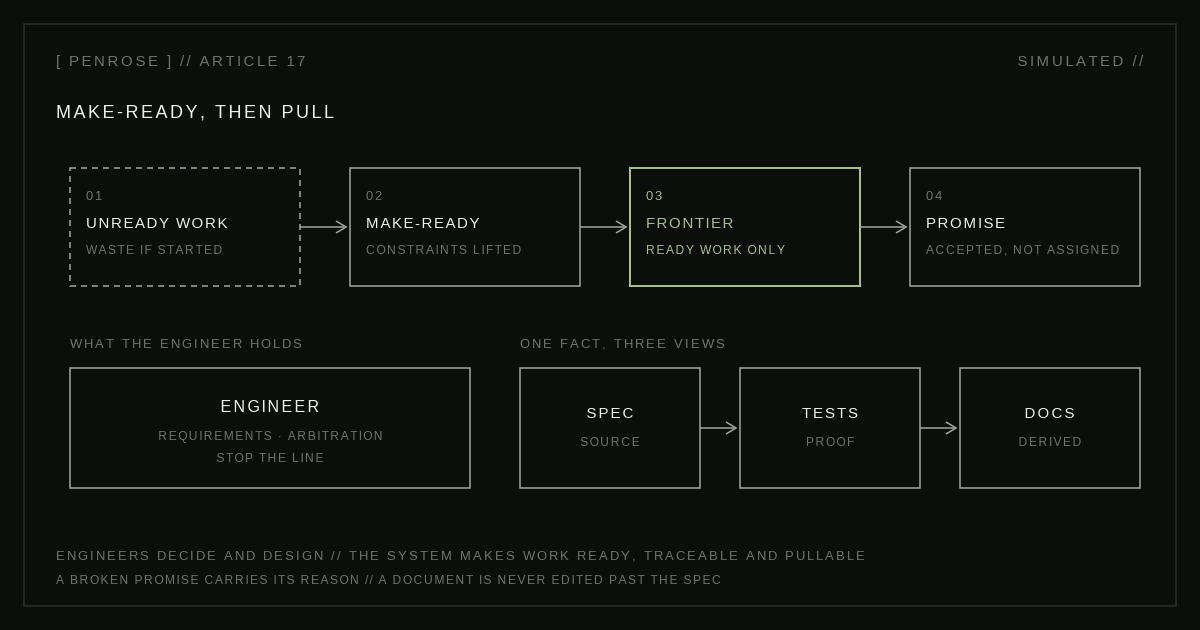
Penrose Tactical built a house production system so developers can multiply their actions without lowering the bar. Work is pulled only when it is ready. Promises replace tickets. Specs, tests and documents stay on the same fact.
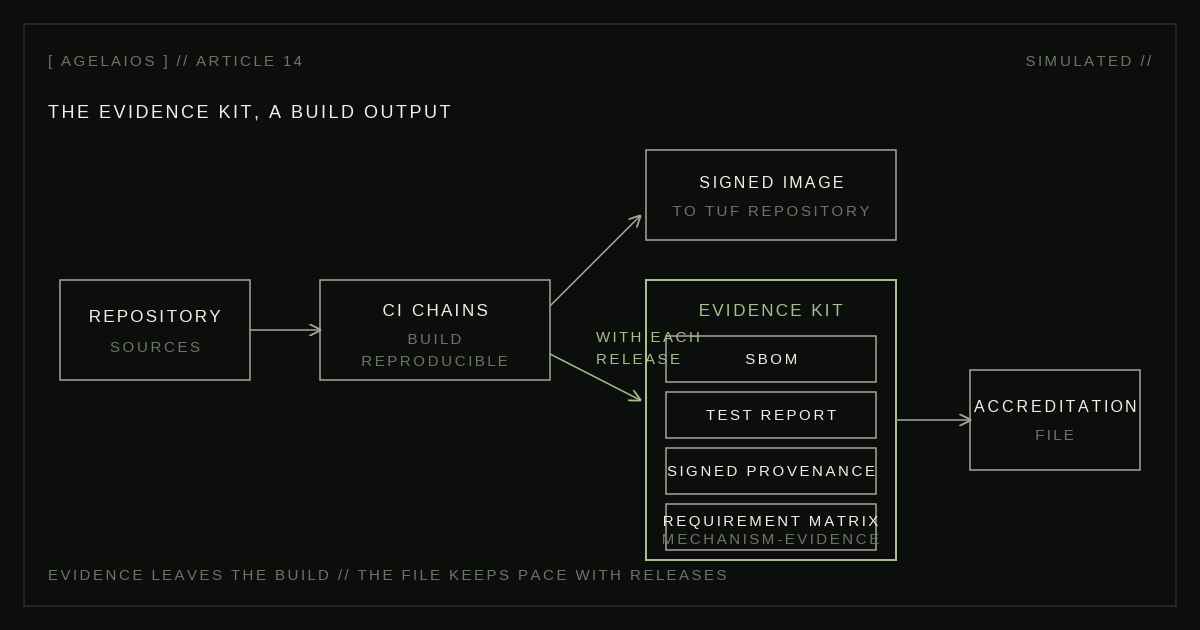
AGELAIOS produces an instance evidence kit with every release, including an SBOM, a dated test report, signed provenance and a requirement-mechanism-evidence matrix, so the accreditation file can move at the same pace as the software.
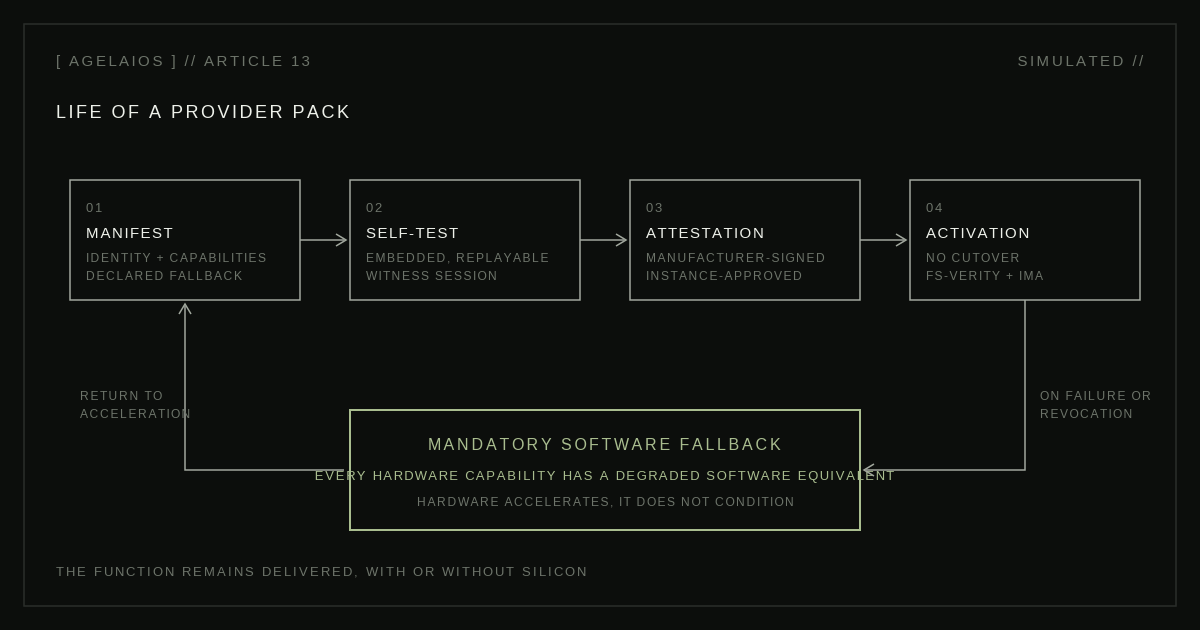
A Provider Pack lets a manufacturer expose silicon to AGELAIOS nodes as a signed capability, with a replayable witness session, fleet integrity controls and a mandatory software fallback that keeps the function available when hardware is not.
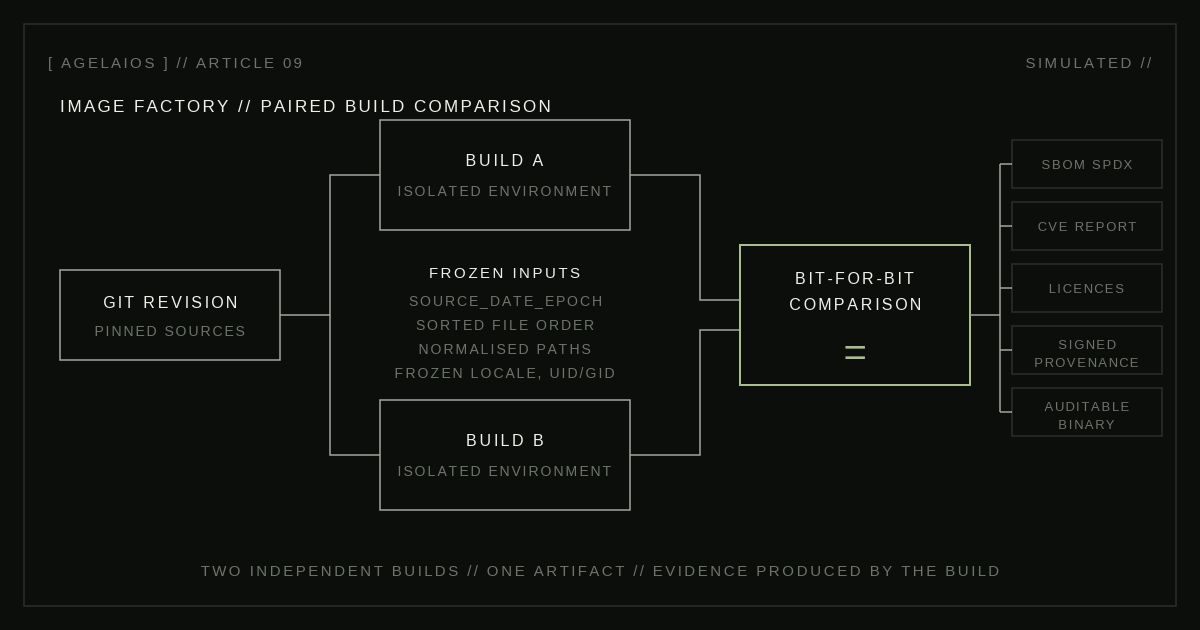
AGELAIOS builds the same revision twice and compares the results byte for byte. See how reproducible images, signed provenance and continuously generated evidence make software assurance easier to demonstrate.
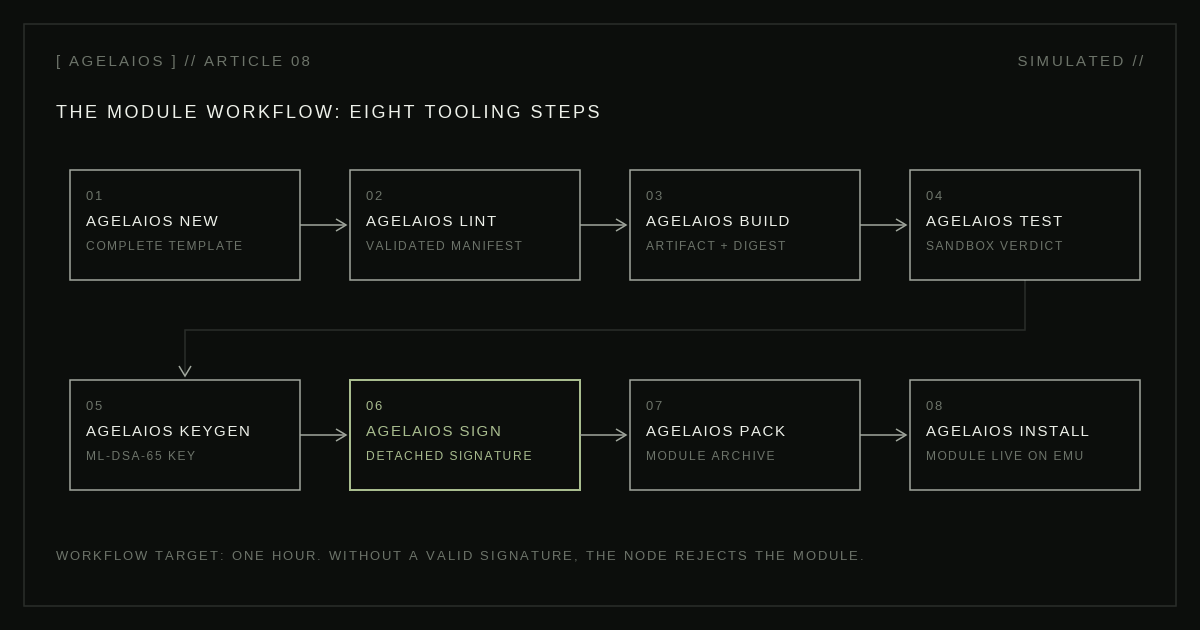
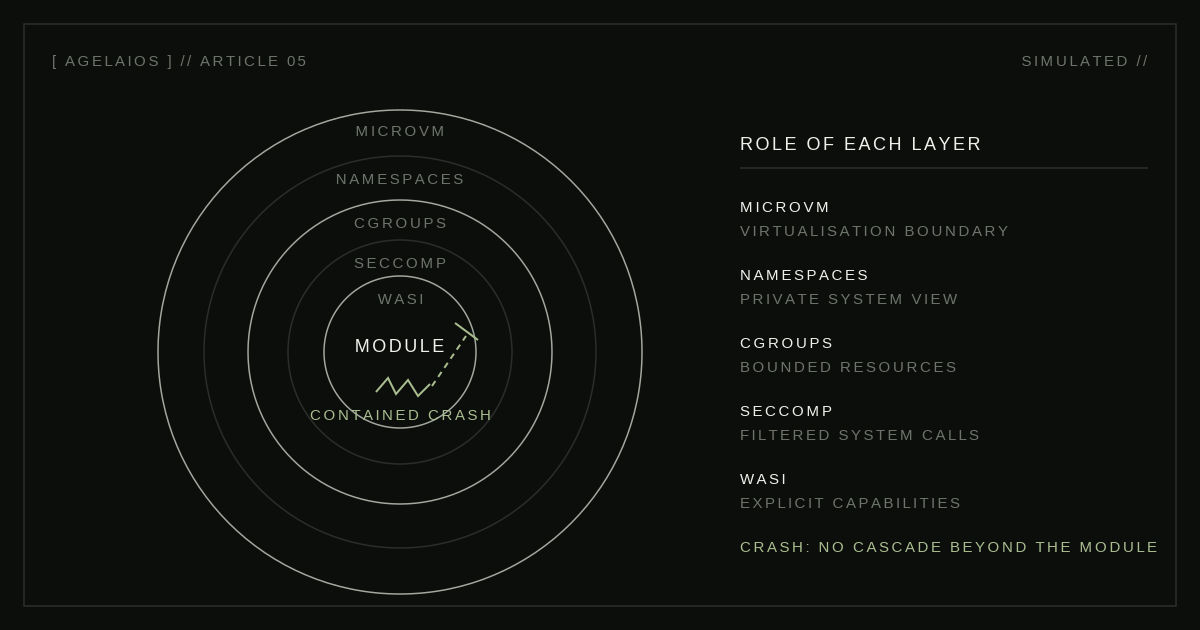
A practical guide to the eight-step AGELAIOS module workflow, from a validated template to a signed package running on an emulated node, with clear choices for contracts and isolation.
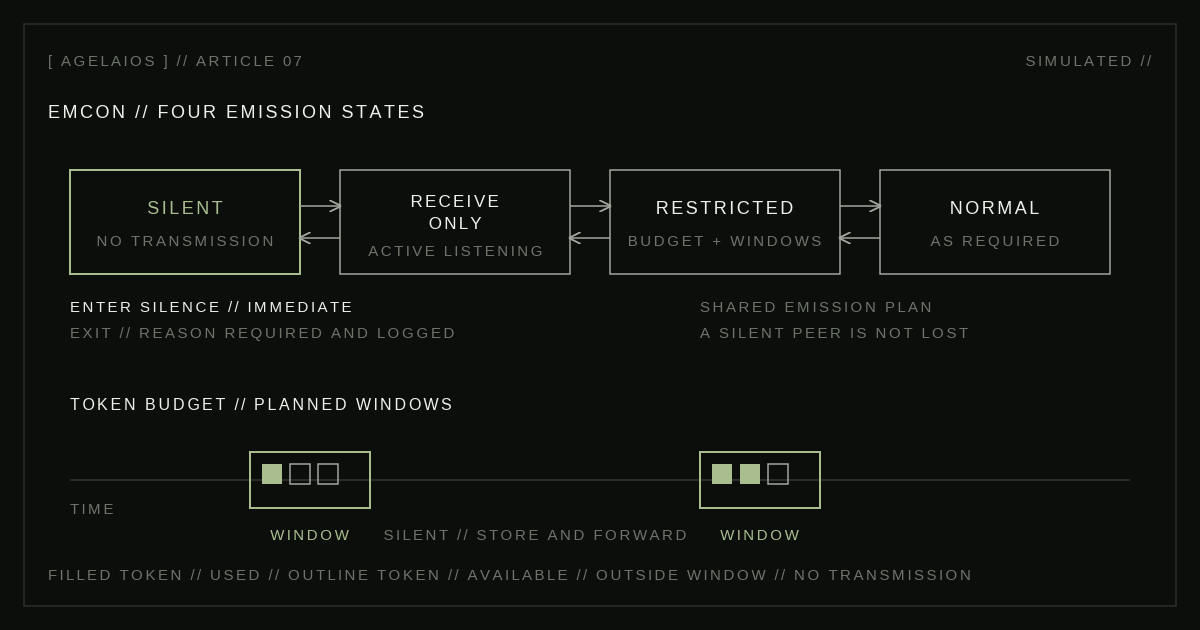
AGELAIOS turns emission control into an enforceable platform capability with explicit operating states, per-bearer transmission budgets, planned windows and store-and-forward delivery.
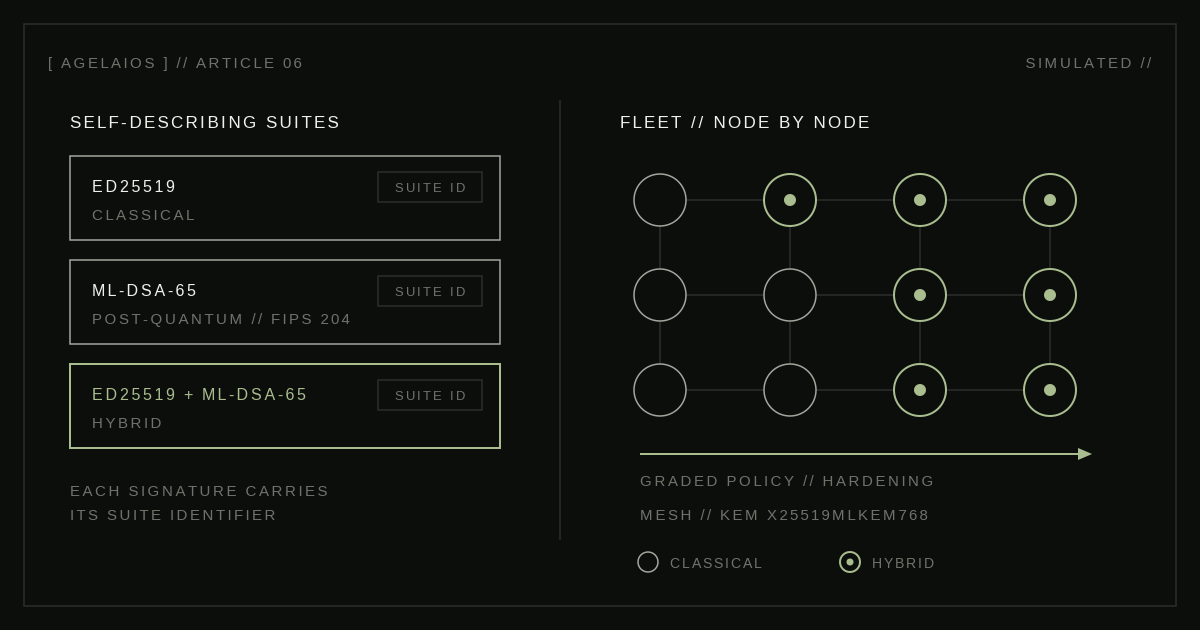
AGELAIOS protects mesh confidentiality with hybrid X25519MLKEM768 key exchange and supports a controlled, verifiable migration of artifact signatures from Ed25519 to ML-DSA-65.
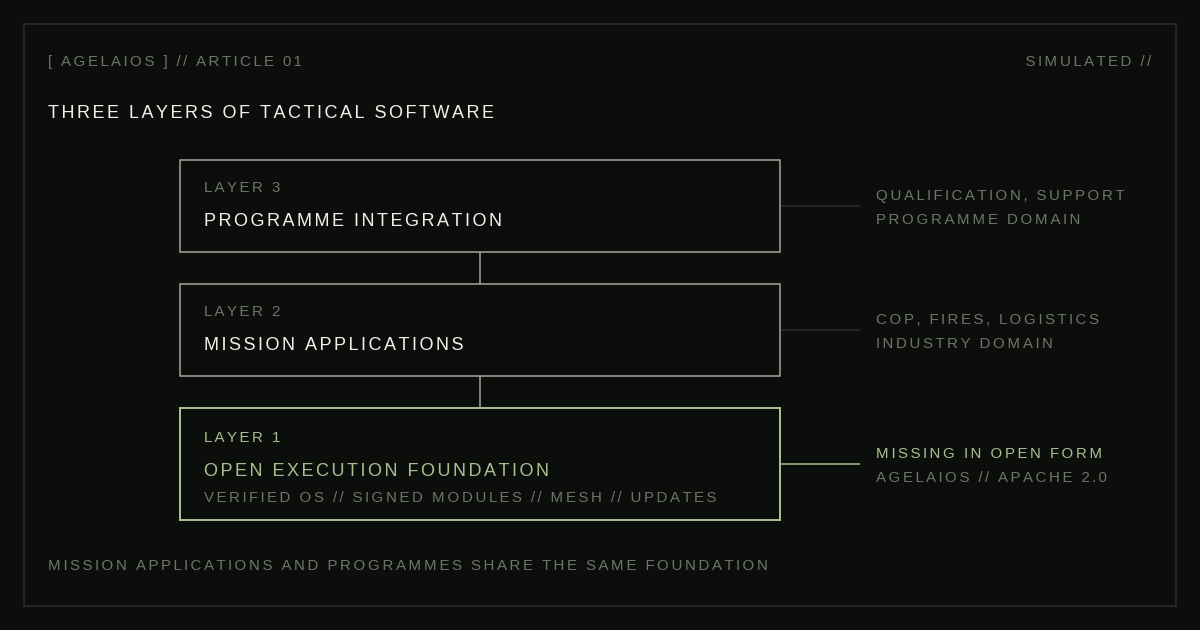
Penrose Tactical will release the AGELAIOS Standard Edition under Apache 2.0 so partners can inspect, port and audit the tactical foundation before a programme starts. Operational secrets stay closed. Industrial delivery is what you buy.
04/What we already deliver
Results, not intentions.
1.5Mlines of code (1,549,407), two-thirds Rust, 42% of which are tests.
1,066requirements traced across 34 domains, 89% covered by at least one test.
5,476automated and end-to-end test references tied to those requirements.
566pages of illustrated user documentation at ASD S1000D standard.
6–7TRL maturity, demonstrated on emulators and commercial hardware.
AGELAIOS is designed as an auditable, specified and documented foundation, ready to embed quickly in any project or programme. Every figure is regenerated by script from the repository and the acceptance dossier, never typed by hand.
A reproducible build means a third party rebuilds the binary from source and obtains exactly the same result, fingerprint included. That is the reference method to verify that what runs is what was audited.
05/Our test means
Built on our own benches, proven in our own trials.
AGELAIOS is developed and qualified with two stations we built for ourselves: TALOS on the lab bench, ARGUS at the edge of the trial site. They are support means for our own engineering, not products for sale.
2stations, from the lab bench to the trial field
203,413lines of code, 40% of them tests
29operator views
43requirements traced in the acceptance dossier
ATALOS · Operator console
BReal bench · 2026-10-24
AThe TALOS console: the bench, its schema, its screen, its console and its relays, under the lock of a single holder.
BA real bench seen by TALOS: the booked board, its boot state and the relays that drive it.
Test means / TALOS
Hardware-in-the-Loop driven by our AI agents
With TALOS, we bring real hardware directly into the software development and validation cycle. Our AI agents can book a test bench, control a board’s power and reboot, access its console, analyse its display and check test results. This approach automates test operations on physical equipment, beyond traditional simulation environments.
Direct interaction with the equipment. Through an MCP gateway, agents access programmable power supplies, control relays, serial consoles and video capture systems. They can carry out remotely the operations a technician would usually perform on a test bench.
Continuous validation on real hardware. Software is tested directly on the boards, terminals and instruments it is built for. Regression campaigns can run on the target equipment, without relying solely on emulation or simulation.
Human control of sensitive operations. Access to the benches relies on exclusive booking. Every intervention is logged and tied to its author, whether a user or an AI agent. Sensitive commands remain subject to explicit human approval.
Shared infrastructure, accessible remotely. Development teams and AI agents share access to the test benches from the lab’s private network. They can book equipment, follow tests and intervene remotely, with no need to be physically on site.
AThe ARGUS composite view: every node of the trial with its resources, and every video, audio or sensor flow traced along its whole path.
BThe operator station: the fleet, the mesh and the clock state of every node, in a single window.
Test means / ARGUS
See a whole fleet under trial, and understand what it does.
ARGUS is the supervision station deployed at the edge of a trial site: it observes every node of the fleet, every link and every flow, acts on nodes in test posture, and records it all to replay it realigned in time.
The plan against reality. Every planned node and every observed node, with its role, posture and versions; deviations from the plan stand out as soon as they appear.
The network from every side. Logical mesh with measured throughput and error rates, physical mesh on a map or globe, clock synchronisation with spoofing detection.
A composite view of the trial. Every node with its resources, packages and gateways, and every flow traced along its whole path, its width proportional to its throughput.
Coordinated fleet recording. The station arms every node, gathers their recordings, merges them and replays them realigned, with bookmarks dropped in one gesture during the trial.
An audited debugging plane. Telemetry, packages, identities and hardware buses of each node, read and driven from the station; every operator or agent action logged with its author.
Several screens, one session. Operator station, display wall and a public screen for visitors, on which node identifiers are pseudonymised and sensitive views masked.
A standard is worth only as much as the players who use it. Here are all those we are building with.
07/Who we are
Six people, one shared vision.
Ruggedised hardware
We have designed munitions and computers for severe environments.
+
Programmes
We have run programmes inside the major prime contractors.
+
Public procurement
We know how to bid for French and European public contracts.
+
Generative AI
We command it everywhere it bites: from specification through to validation.
Penrose Tactical
We are a multinational defence company, present in Europe and Asia-Pacific and based in France. We come from the defence industry and we are returning to it to serve, on the timetable the situation sets.