
When every transmission can reveal your position

Doctrine
On a battlefield shaped by electronic warfare, transmitting is never a neutral act. A radio burst can disclose direction, timing, movement patterns and eventually a position. Encryption can protect what a message says. It cannot conceal the fact that a transmitter has spoken.
This creates a difficult choice for command systems. They must distribute orders, sensor reports and positions, yet every exchange can increase the electromagnetic exposure of the force. A conventional platform leaves that tension to procedures and operator discipline. AGELAIOS brings it into the technical design.
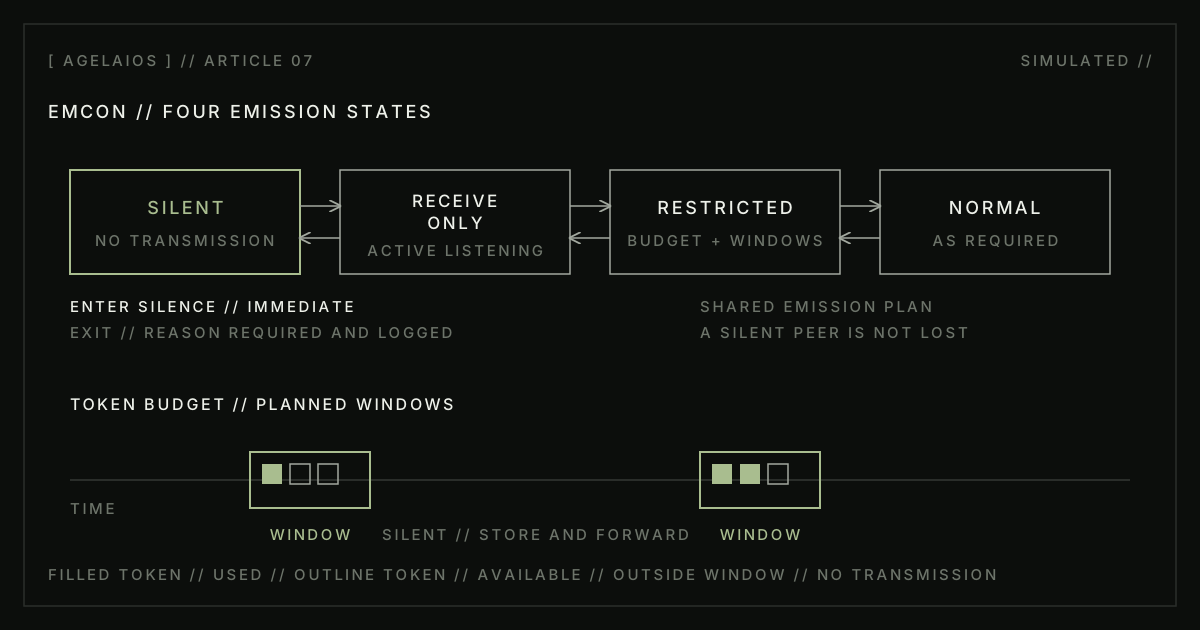
The platform treats emission control, or EMCON, as a managed operating condition alongside identity, integrity and connectivity. Nodes can enter an explicit emission state, enforce a budget for each bearer, concentrate traffic into planned windows and preserve useful data while radios remain quiet. The objective is concrete: turn an instruction such as “transmit less” into behavior that can be configured, measured and audited.
Encryption does not make a transmitter invisible
United States joint doctrine defines EMCON as the selective and controlled use of emitters to reduce detection while maintaining command and control capability [1]. Recent operational evidence gives that principle renewed urgency.
RUSI reporting on the war in Ukraine documents dense electronic warfare deployments and the interception of tactical communications in real time, including encrypted traffic [2]. Earlier analysis of the conflict describes the short sequence from emission detection to geolocation and attack [5].
The distinction matters. Strong cryptography can deny access to the payload, but an observer may still learn that a unit is present, which direction the signal came from, how often it communicates and how its activity changes before an operation. A highly encrypted node can therefore remain highly observable.
For acquisition teams, this changes the question. It is not enough to ask whether communications are confidential and authenticated. A tactical platform should also explain how it limits the signature created by those communications.
Chosen silence is not a network failure
Most distributed systems are designed to restore connectivity as quickly as possible. When a link disappears, they retry, rediscover peers, elect new roles and raise the frequency of health checks. That response is sensible in a data center. Under EMCON, it can be dangerous.
Consider a node that deliberately stops transmitting for thirty minutes while moving through an exposed area. If the mesh interprets that silence as a fault, neighbouring nodes may begin probing it. They may repeat announcements, trigger recovery traffic or reorganize the topology. One disciplined node can then cause the rest of the network to become louder at precisely the wrong time.
Denied, disrupted, intermittent and limited connectivity, commonly described as DDIL, addresses a network condition that the system must endure. EMCON expresses an operational decision that the system must respect. AGELAIOS models these situations separately. A node can be connected in principle while choosing not to transmit, and its peers can reason about that choice without declaring it lost.
This is the first commercial value of making EMCON a platform capability. Emission discipline no longer depends on every application implementing silence correctly. The foundation enforces a common state across the node.
Four states make intent explicit
AGELAIOS defines four emission states, from the most restrictive posture to normal operation.
- Silent. The node does not transmit. It continues local processing, timestamps incoming data available to it and stores outbound messages for later delivery.
- Receive only. Data transmission remains disabled while configured bearers continue active reception and acquisition.
- Restricted. The node may transmit only within allocated budgets and planned windows.
- Normal. Applications may communicate as required, subject to the bearer discipline and security policies that remain in force.
These are not labels added to a dashboard. The state constrains what the node is allowed to do. Applications cannot quietly override a restricted posture simply because they have lost contact or accumulated messages.
The model also gives operators and integrators a shared vocabulary. “The link was down” and “the node was silent by order” describe different situations, require different responses and leave different audit evidence. Treating them as separate states removes ambiguity from both operations and after-action analysis.
Restricted mode turns restraint into a budget
Instructions such as “use the radio sparingly” are hard to enforce and harder to assess. In restricted mode, AGELAIOS accounts for transmissions with tokens. Each permitted transmission consumes part of a budget allocated for a bearer and a period. Once that budget is exhausted, the requesting module waits for the next allocation unless policy grants an explicit adjustment.
Budgets are set per bearer because different transmissions create different operational exposure. A directional SATCOM exchange, a VHF burst and a tactical LTE session do not have the same propagation pattern, duration or likelihood of detection. AGELAIOS applies one emission state to the node while allowing each bearer to carry its own budget or to be closed independently.
This produces evidence that a verbal policy cannot provide. An operator can inspect which bearer transmitted, when it transmitted, which allocation it consumed and whether an exception was granted. A mission planner can compare the intended posture with observed behavior. An evaluator can test whether traffic actually stops when the budget reaches zero.
Planned windows add control over timing. Instead of allowing low-volume traffic to leak continuously, the platform can concentrate authorized exchanges into short periods. Windows may be offset between nodes to avoid predictable fleet-wide activity. Outside those periods, the node remains quiet by construction.
A silence plan keeps the mesh from guessing
Silence becomes much safer when peers know it is intentional. Before entering a restrictive state, a node can share an emission plan that describes its expected states, communication windows and duration.
Suppose a vehicle announces that it will remain silent until 14:20 and then open a ninety-second window. Peers do not need to probe it throughout the interval. They can queue traffic and wait for the declared opportunity. If the vehicle returns during the expected window, the plan has been followed. If it remains absent afterwards, the mesh can classify the silence as unexplained and apply the appropriate loss logic.
The plan does not eliminate uncertainty, and it does not guarantee that the node will be available at the scheduled time. Terrain, damage or mission changes can still intervene. Its value is narrower and more useful: it lets each peer distinguish planned silence from an unexpected disappearance using information that can be processed automatically.
That distinction reduces avoidable traffic and makes the network’s response more predictable. It also lets a force coordinate emission discipline without relying on an always-available central service.
Store and forward protects operational continuity
Radio silence should not mean data loss. AGELAIOS uses a store-and-forward model informed by delay-tolerant networking principles described in RFC 4838 and Bundle Protocol Version 7 in RFC 9171 [3] [4]. Messages created while transmission is unavailable are retained and considered when a window opens.
The queue follows three rules.
- Strict priority. Higher-priority messages are sent before lower-priority traffic.
- Latest-value coalescing. For changing state such as position or system status, the queue retains the most recent useful value instead of transmitting every superseded update.
- Hot-zone precedence. Within the same priority, information related to the active engagement area is sent before traffic from quieter areas.
Imagine that a node remains silent for two hours while its position changes every few seconds. Sending the entire history when the radio reopens would consume the window without improving the current operational picture. Coalescing sends the latest relevant position. Strict priority ensures that an urgent order is not trapped behind routine telemetry. If the budget permits more traffic, the remaining queue can follow.
The result is a short, information-dense transmission opportunity. Essential data moves first, stale repetition is removed and lower-value traffic cannot silently consume the whole allocation.
The interface supports the decision under pressure
EMCON only works if operators can apply it quickly. Entering silence is therefore designed as a protective action. It can be triggered by one operator action or by a configured event such as jamming detection, crossing a phase line or receiving an authenticated order. The state then applies across the node without a sequence of confirmation dialogs.
Leaving silence is intentionally different because it increases exposure. The operator provides a reason, and the platform records who resumed transmission, when it happened and why. This is not intended to prevent an authorized operator from acting. It creates accountability for the action that changes the node’s electromagnetic posture.
The asymmetry follows operational risk. Protection should be immediate. Exposure should be deliberate and reviewable.
What is implemented and what remains in progress
AGELAIOS publishes a defined implementation boundary rather than presenting the complete model as universally deployed.
At the publication date, the reference project reports that the core emission state machine, token accounting and store-and-forward queues with strict priority and coalescing are covered by its public automated test suite. That suite contains approximately 930 tests and can be replayed on x86-64 and ARM64 emulated targets.
Integration with radio, SATCOM and tactical LTE or 5G bearer daemons is still in progress. Not every bearer driver is fully connected to the transmission-budget mechanism. The published EMCON demonstration therefore covers the bearers that have already been integrated. It should not be read as evidence that every target radio or deployment profile is supported today.
This boundary is important for a serious evaluation. The state model can be inspected now. Budget exhaustion, queue ordering and planned windows can be tested now. Bearer-specific behavior still needs to be validated against the radios, waveforms, drivers and policies selected for an actual deployment.
Evaluate behavior rather than a feature label
Many products can place EMCON on a capabilities slide. A useful assessment goes further.
Ask the platform to enter silence while applications continue producing traffic. Confirm that no integrated bearer transmits. Reopen a constrained window and inspect which messages leave first. Exhaust a bearer budget and verify that further requests wait. Share a silence plan with peers and observe whether they avoid unnecessary recovery traffic. Finally, review the event record for state changes, exceptions and the reason given when transmission resumed.
These checks reveal whether emission control is a procedure around the software or a property enforced by the software.
AGELAIOS is designed for the second standard. It does not claim that software can make radio use risk-free, prevent every form of detection or replace spectrum planning. It provides a technical foundation for applying an EMCON policy consistently across a tactical node, preserving useful work during silence and producing evidence that the policy was followed.
For operators, that means greater control over when a node becomes observable. For integrators, it means one enforceable model instead of separate conventions in every module. For decision-makers, it means the proposition can be tested against representative bearers before deployment.
When every transmission can reveal a position, disciplined silence should not depend on good intentions alone.
Sources
- U.S. Joint Chiefs of Staff, “Joint Publication 3-85, Joint Electromagnetic Spectrum Operations”, 2020, https://irp.fas.org/doddir/dod/jp3_85.pdf
- Jack Watling and Nick Reynolds, RUSI, “Meatgrinder: Russian Tactics in the Second Year of Its Invasion of Ukraine”, 2023, https://www.rusi.org/explore-our-research/publications/special-resources/meatgrinder-russian-tactics-second-year-its-invasion-ukraine
- IETF, “RFC 4838, Delay-Tolerant Networking Architecture”, 2007, https://www.rfc-editor.org/rfc/rfc4838
- IETF, “RFC 9171, Bundle Protocol Version 7”, 2022, https://www.rfc-editor.org/rfc/rfc9171
- Mykhaylo Zabrodskyi, Jack Watling, Oleksandr V. Danylyuk and Nick Reynolds, RUSI, “Preliminary Lessons in Conventional Warfighting from Russia’s Invasion of Ukraine: February to July 2022”, 2022, https://www.rusi.org/explore-our-research/publications/special-resources/preliminary-lessons-conventional-warfighting-russias-invasion-ukraine-february-july-2022